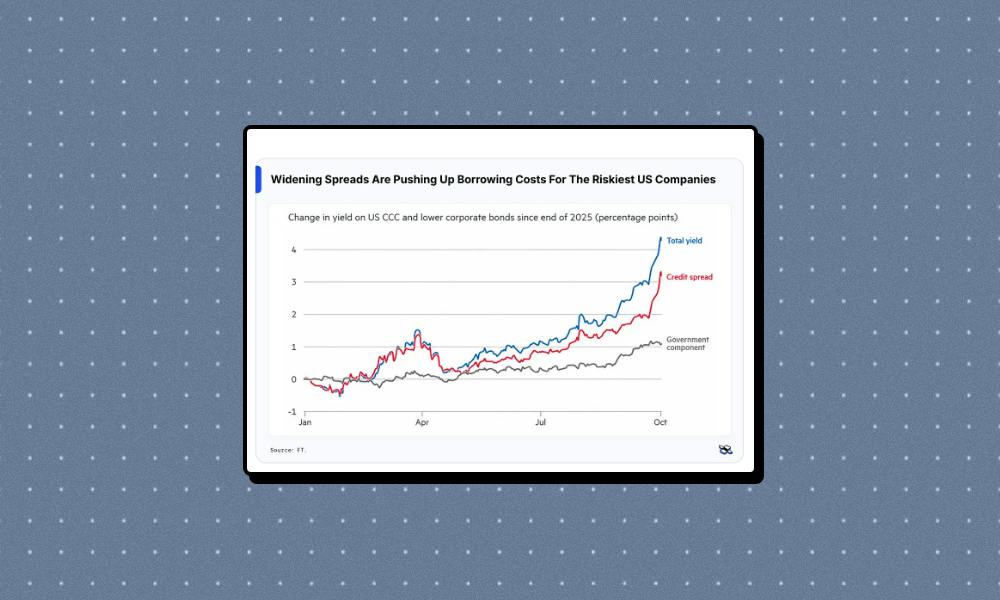
The bill for Corporate America's borrowing binge is getting bigger. A selloff in US government bonds has pushed Treasury yields sharply higher, and investors are now demanding fatter premiums to hold the debt of the country's most indebted companies. The result: borrowing costs for the riskiest firms have climbed to 17% — the highest level since May 2020.
That number matters because it sits at the intersection of two forces. First, Treasury yields — the benchmark for borrowing costs across the economy — have been rising as investors sell government bonds. Second, credit spreads on the lowest-rated corporate debt have widened to their widest since 2022. A credit spread is the extra yield investors demand over a risk-free Treasury to compensate for the chance a company might default. When spreads widen, it signals that lenders see more danger ahead.
Why borrowing costs are climbing
The combination of higher Treasury yields and wider spreads is a one-two punch for companies that loaded up on debt during the cheap-money era. For years, low interest rates made it easy for firms to borrow heavily to fund buybacks, acquisitions, and expansion. Now that the era of easy money has faded, those debts are coming due at far less forgiving terms.
For the lowest-rated companies — often referred to as "junk" or "high-yield" borrowers — the cost of new debt has jumped to 17%. That's a level not seen since the early days of the pandemic, when markets were in turmoil. For context, a company paying 17% on a $1 billion bond would owe $170 million in interest every year. That's a heavy load for any business, and it can quickly eat into profits or force painful cutbacks.
The widening of credit spreads to their highest since 2022 suggests that investors are increasingly worried about defaults. When spreads widen, it means lenders want a bigger reward for taking on risk. That's a classic sign of stress in the corporate bond market, and it often precedes a rise in default rates.
AI is the exception
Not every company is feeling the squeeze. AI-focused firms are still borrowing aggressively, betting that building data centers and other infrastructure will pay off despite the higher interest expense. These companies are essentially making a calculated wager: the future profits from artificial intelligence will outweigh the cost of borrowing today.
That dynamic is visible in the broader market. While many firms are pulling back on new debt, AI-related capital spending continues to surge. The logic is that data centers and computing power are the "picks and shovels" of the AI gold rush, and companies want to secure that capacity before competitors do. But it's a risky bet, especially if interest rates stay high or if AI revenue growth disappoints. As we've noted, AI's debt surge signals rising risk, and the stakes are only getting higher.
What it means for investors
For everyday investors, the rising cost of corporate debt is a signal to pay attention. If you own bond funds or ETFs that hold high-yield corporate debt, the widening spreads mean those bonds are losing value, even if the yields look attractive. The higher yields are a reward for taking on more risk, but that risk is real: defaults tend to rise when borrowing costs climb this high.
For stock investors, the impact is more indirect but still important. Companies with heavy debt loads will see their interest expenses rise, which can eat into earnings and limit their ability to invest in growth or return cash to shareholders. That's especially true for smaller, more leveraged firms. On the other hand, companies with strong balance sheets and low debt may actually benefit, as they can pick up market share from struggling rivals.
The AI exception is worth watching too. If AI-related companies keep borrowing at these elevated rates, they're making a big bet on future growth. That bet could pay off handsomely, but it also adds risk to the broader market. As Skydance's bigger streaming bet comes with a debt catch, so too does the AI buildout.
The bigger picture
The rise in corporate borrowing costs is part of a larger story about the end of cheap money. Central banks around the world have been tightening monetary policy to fight inflation, and that has pushed up interest rates across the board. For companies that borrowed heavily when rates were near zero, the refinancing wall is approaching. Many will have to roll over debt at much higher rates, and some won't be able to.
That's why credit spreads are widening: investors are pricing in a higher chance of defaults. The last time borrowing costs were this high, in May 2020, the economy was in the depths of the pandemic recession. Today, the economy is in better shape, but the debt load is much larger. Corporate America's debt binge is coming back to bite, and the bill is getting bigger.
For now, the pain is concentrated in the riskiest corners of the market. But if Treasury yields keep climbing or the economy slows, the squeeze could spread. Investors should keep an eye on credit markets as a leading indicator of stress. As we've seen in Latin American markets slipping as oil nears $100 and the dollar strengthens, global financial conditions are tightening, and that has ripple effects everywhere.