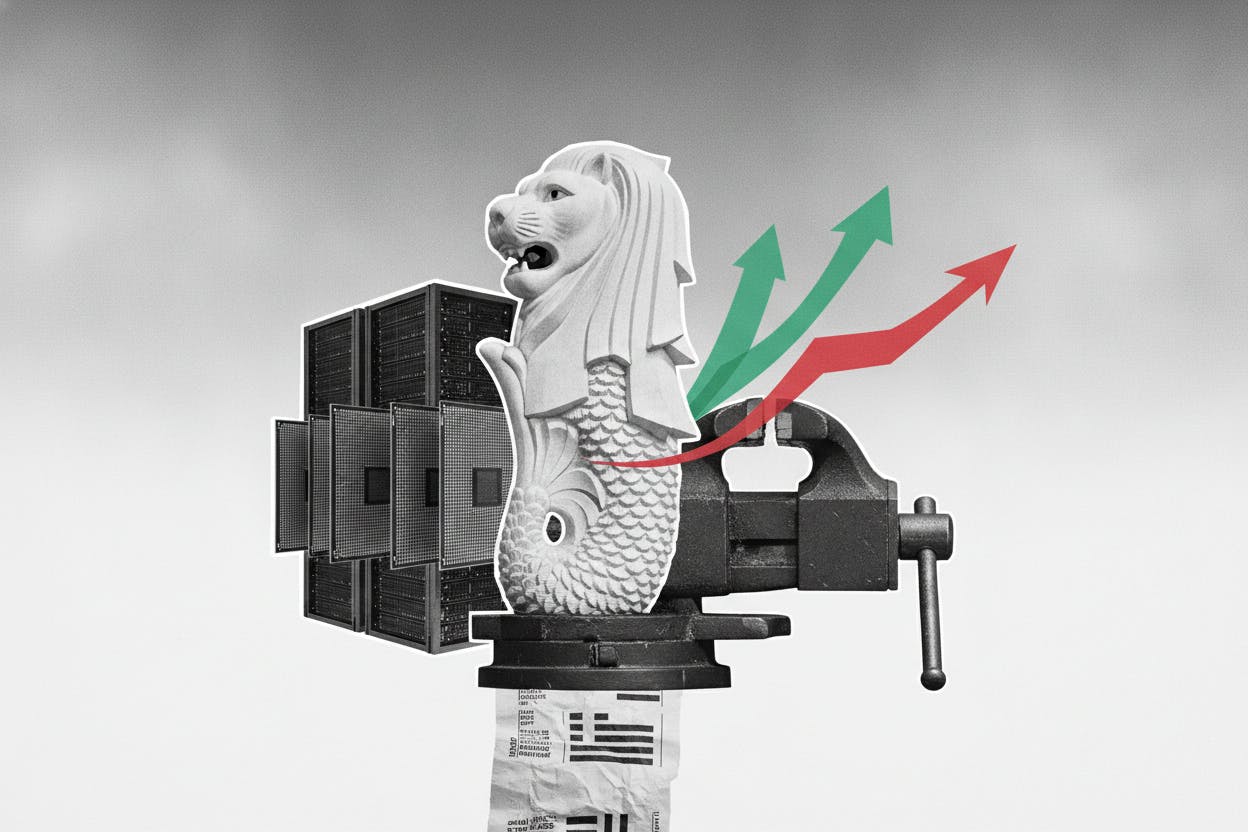
Singapore's central bank, the Monetary Authority of Singapore (MAS), has painted a broadly positive picture for the economy through the rest of 2026, but it warns that the artificial intelligence investment boom is a major wild card that could either keep inflation elevated or suddenly fade and hurt global spending.
In its annual report released Tuesday, MAS Managing Director Chia Der Jiun said the economy should see firm growth in the second half of 2026, with AI-related demand continuing to support the expansion. Singapore also reported preliminary growth of 5.7% in the second quarter compared with a year earlier, while the trade ministry expects full-year 2026 growth of 2% to 4%.
What the MAS said about AI and inflation
The MAS acknowledged that the surge in AI-related investment has been a key driver of Singapore's recent growth, particularly in sectors like semiconductors, data centers, and tech services. However, officials cautioned that this boom carries two-sided risks.
On one hand, if AI investment continues to accelerate, it could stoke inflation by driving up demand for resources, labor, and components. That would complicate the MAS's job of keeping price pressures under control. On the other hand, if the AI spending frenzy fades — as some analysts have warned it might — it could drag on global business spending and hit Singapore's export-dependent economy hard.
This dual risk is not unique to Singapore. Across Asia, investors have been watching closely whether AI-related spending will sustain its momentum or cool off. For example, Singapore stocks have dipped recently as AI spending doubts spread across the region, reflecting the market's sensitivity to any signs of a slowdown in tech investment.
Singapore's growth outlook in context
Singapore's economy has been a relative bright spot in Asia, benefiting from strong demand for advanced chips and AI infrastructure. The 5.7% year-on-year growth in the second quarter was well above many forecasts, though some of that strength reflects a low base from the previous year.
The trade ministry's forecast of 2% to 4% growth for 2026 suggests that officials expect the economy to moderate from the current pace but remain healthy. That range is consistent with Singapore's long-term trend growth, though it leaves room for the AI wild card to push the outcome toward either end.
The MAS's assessment also comes amid a broader backdrop of cautious central bank messaging globally. Central banks in Malaysia and New Zealand have also flagged steady but fragile growth, while the U.S. Federal Reserve has kept rates elevated to combat lingering inflation.
What it means for investors
For everyday investors, the MAS's message is a reminder that even strong economic growth can come with hidden risks. The AI boom has been a powerful tailwind for tech stocks and related sectors, but it also introduces uncertainty about how long the spending cycle will last.
If AI investment continues to surge, it could keep inflation higher for longer, which might delay any interest rate cuts by central banks, including the MAS. Higher rates tend to weigh on stock valuations, especially for growth-oriented companies. Conversely, if AI spending fades, it could hit demand for semiconductors, data center equipment, and other tech exports that Singapore relies on.
Investors should also note that the MAS's growth forecast for 2026 is relatively wide — 2% to 4% — which reflects the uncertainty around the AI factor. A growth rate at the lower end of that range would still be respectable, but it would signal a significant slowdown from the current pace.
For those with exposure to Singapore stocks or Asian tech funds, the key question is whether AI-driven demand can sustain its momentum. Recent earnings reports from major chip companies and tech firms have been mixed, with some seeing strong AI-related orders while others face headwinds from weaker non-AI demand. For instance, Cadence Design Systems recently lifted its 2026 outlook on surging AI chip design demand, a positive sign for the sector. But broader concerns about a potential slowdown in AI spending have weighed on sentiment.
The bottom line
Singapore's economy is on solid footing, but the AI investment cycle is the biggest swing factor for the outlook. The MAS has done investors a service by flagging this risk clearly, even as it maintains a positive baseline view. For now, the central bank sees firm growth ahead, but it's keeping a close eye on whether the AI boom turns into a source of inflation or a drag on spending — and investors should too.