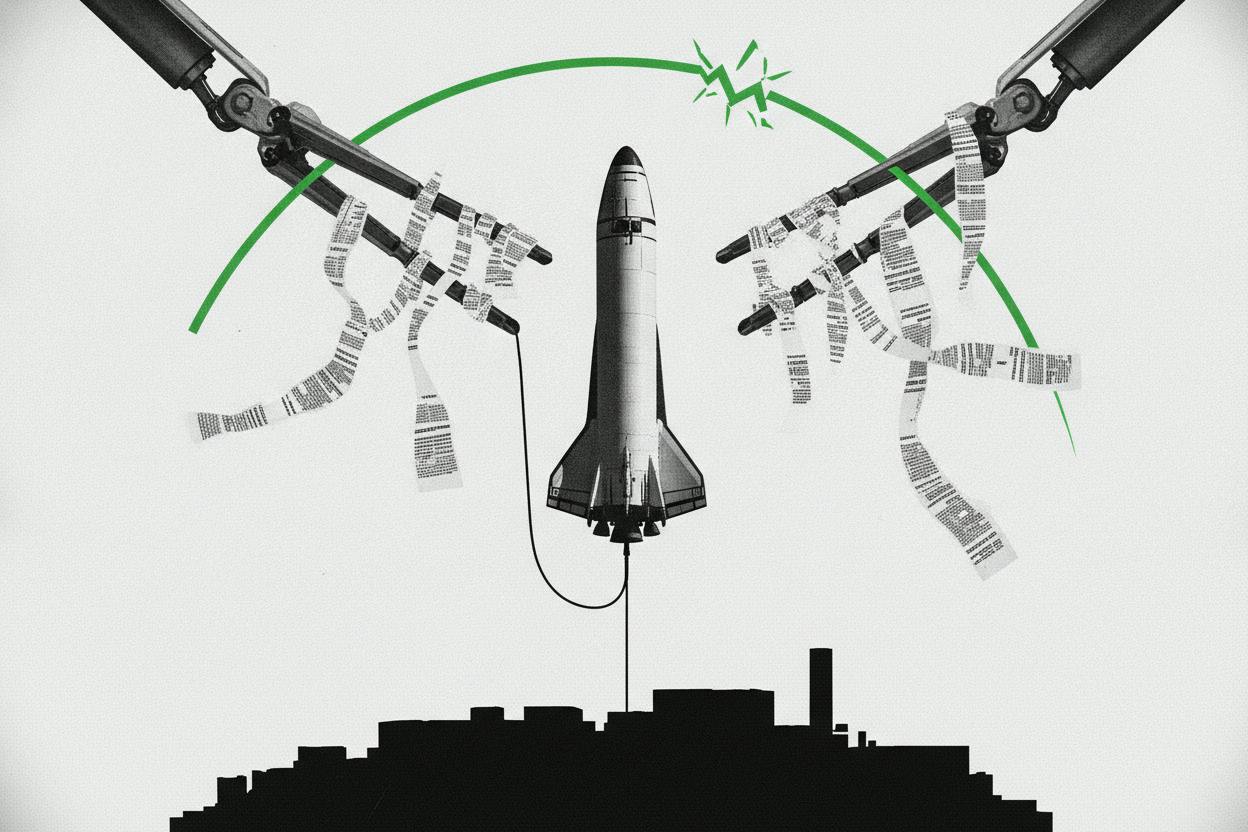
SpaceX achieved a significant milestone on its latest Starship test flight, catching the rocket's upper stage after launch—a first for the program. The feat, dubbed "Flight 15," drew praise from RBC Capital Markets, which said it brings full reusability closer to reality. But the bank also cautioned that SpaceX's ambitious expansion plans, including a $74 billion-plus data-center buildout and its work with NASA, could face tougher political scrutiny after the midterm elections.
Why the catch matters
For those unfamiliar, Starship is SpaceX's next-generation rocket, designed to carry both crew and cargo to orbit, the Moon, and eventually Mars. The "catch" refers to the upper stage—the part that typically burns up or is discarded—being recovered after launch, much like the company's Falcon 9 boosters. The difference is that Starship is far larger and more complex, making recovery a bigger engineering challenge.
RBC's key point is that this isn't just a flashy stunt. Reusability is the lever that can lower the cost per launch, because more of the vehicle can be flown again instead of being rebuilt. If the learning curve keeps improving, it could eventually support SpaceX's other ambitions, including its Starlink connectivity business and an AI push that depends on massive computing power.
The $74 billion question
That's where the politics come in. RBC notes that SpaceX is developing two giant "supercompute" sites—one in the Rio Grande Valley, Texas, and another in Cochise County, Arizona—with a combined investment of more than $74 billion, plus associated energy infrastructure. These projects can run into local opposition and permitting delays, and RBC flagged "near-term headline risk" around additional data-center construction.
The bank also expects more questions around NASA-related contracts after the midterms, even as it acknowledges that NASA has limited alternatives for comparable launch capacity. So while the engineering milestone helps the story, it doesn't remove execution risk on the ground.
What it means for investors
For investors, RBC's $225 price target on SpaceX (if it were publicly traded) depends as much on permitting as it does on rockets. Big data centers are typically valued on when they start generating cash, not when they're announced. If political pushback slows permits or forces step-by-step approvals, construction schedules can stretch out while fixed development costs keep running. That usually lowers the value investors assign to long-dated projects, because the cash flows arrive later.
So even if Flight 15 de-risks reusability, the swing factor for how markets pressure-test RBC's $225 target is whether the Texas and Arizona buildout stays on a predictable timeline. Delays would push out when SpaceX's Connectivity and AI units can turn capacity into revenue, and that matters more to valuation than a single test flight.
SpaceX remains a private company, but its valuation is closely watched by investors through secondary markets and by funds like Ontario Teachers', which recently nearly doubled its SpaceX stake. The company's progress is also a bellwether for the broader space economy, which has seen renewed interest from both public and private players.
For everyday investors, the takeaway is that SpaceX's success isn't just about rockets—it's about the business of turning engineering wins into revenue. The Starship catch is a positive sign, but the real test will be whether SpaceX can navigate the political and regulatory landscape to bring its data-center plans online. As with any high-growth story, the gap between promise and execution is where risk lives.
Investors should also keep an eye on how these developments affect the broader tech and AI landscape. The demand for computing power is a theme that has driven AI chip stocks and market moves recently. If SpaceX's data centers face delays, it could ripple through the AI supply chain, though the company is just one player in a crowded field.
In the meantime, the Starship catch is a reminder that technological breakthroughs can happen quickly, but their financial impact often takes years to materialize. For investors, patience and a focus on execution metrics—like permitting timelines and revenue generation—are more useful than getting caught up in the excitement of a single test flight.