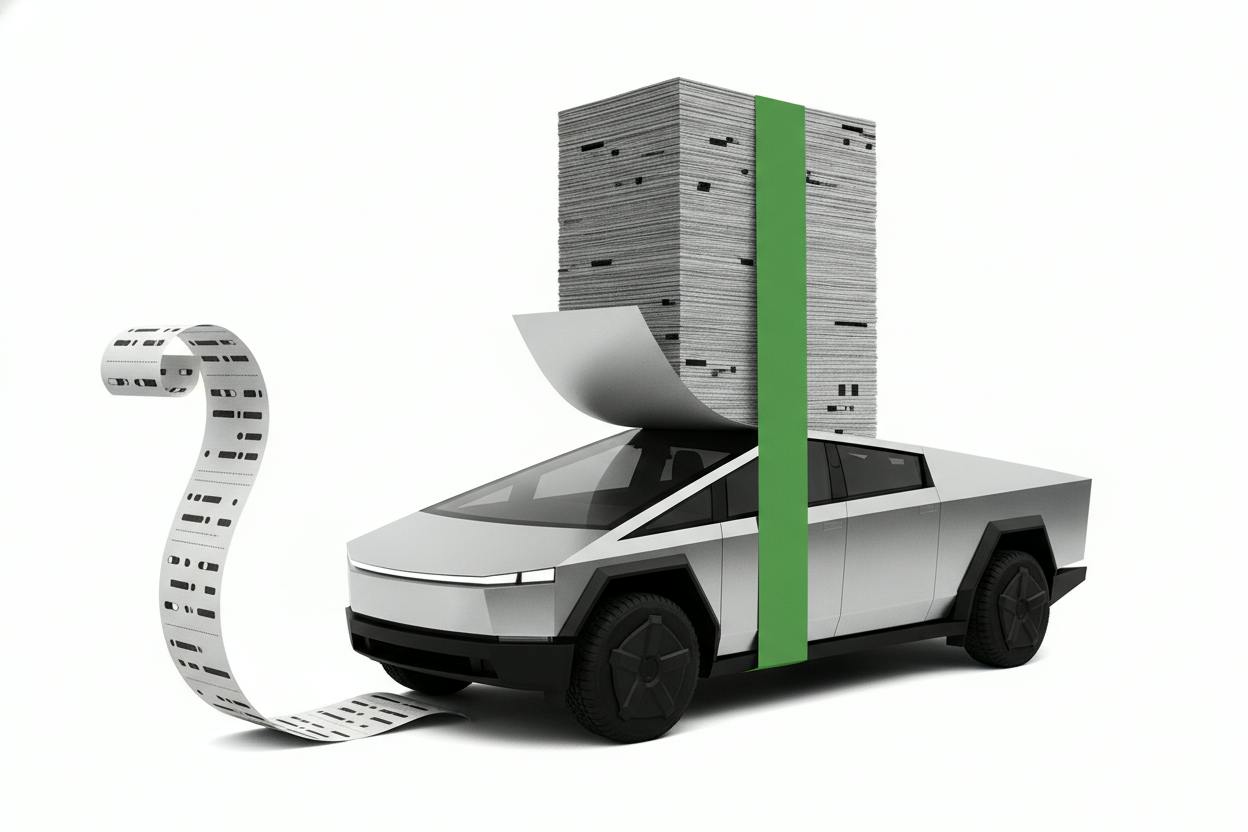
Tesla's Full Self-Driving (FSD) software is increasingly the reason customers choose a Tesla, according to a new analysis from RBC Capital Markets. The investment bank reports that FSD was added to more than 75% of Tesla's North American deliveries in the third quarter, and that paid subscriptions worldwide have climbed to 1.74 million.
That figure represents a significant milestone for the company's software business. At current pricing, those subscriptions are approaching $1 billion in annual recurring revenue — a growing stream that investors are watching closely as Tesla's core auto sales face pressure from competition and price cuts.
What is FSD and why does it matter?
Full Self-Driving is Tesla's advanced driver-assistance system. Despite its name, it does not make the car fully autonomous; drivers must remain attentive and ready to take over. The software handles tasks like lane changes, navigating highway interchanges, and recognizing stop signs and traffic lights. It's sold as a one-time purchase or as a monthly subscription.
For years, Tesla has pitched FSD as a future profit engine — a high-margin software product that could eventually enable a robotaxi network. The company has also tied its valuation to the promise of autonomy, with CEO Elon Musk repeatedly stating that FSD will be the key to Tesla's long-term value.
RBC's data suggests that promise is starting to show up in purchase decisions. When more than three-quarters of buyers in North America choose to add FSD to their new Tesla, it signals that the software is no longer just a novelty for tech enthusiasts — it's becoming a mainstream reason to buy the car.
The subscription math
Tesla doesn't break out FSD revenue separately, but the numbers from RBC give a rough picture. With 1.74 million paid subscribers worldwide, and typical pricing of $99 per month (or a $8,000 one-time fee), the annual revenue run rate is approaching $1 billion. That's still a small slice of Tesla's overall revenue, which exceeded $90 billion in 2023, but it's a high-margin slice.
Software revenue is attractive to investors because it costs relatively little to deliver once the development is done. Unlike building a new factory or sourcing batteries, selling a software subscription to an existing car owner generates almost pure profit. As Tesla's vehicle sales growth slows, this recurring revenue becomes more important to the company's financial health.
RBC's note also highlights a broader trend in the auto industry: software, not engines, is increasingly deciding the next decade of competition. Traditional automakers are racing to build their own connected services, but Tesla has a head start with its over-the-air updates and large installed base.
What it means for investors
For everyday investors, the takeaway is that Tesla is becoming as much a software company as a carmaker. That shift has implications for how you evaluate the stock. If FSD adoption continues to grow, it could support Tesla's premium valuation — the stock trades at a much higher price-to-earnings ratio than traditional automakers, partly because of the software and AI potential.
But there are risks. FSD has faced regulatory scrutiny and safety questions. The name itself has drawn criticism from safety advocates who argue it overstates the system's capabilities. And while subscription numbers are rising, Tesla has also cut FSD prices in the past to boost adoption, which could pressure the revenue per subscriber.
Investors should also watch how FSD revenue interacts with Tesla's broader cost picture. The company has been spending heavily on AI infrastructure and robotaxi development, which has squeezed margins. As we noted in our coverage of Tesla's AI spending squeeze, operating expenses climbed 39% in a recent quarter. FSD revenue could help offset those costs, but it's not yet large enough to cover them entirely.
Another factor to consider is the upcoming launch of the Cybercab, Tesla's purpose-built robotaxi. The company aims to sell a steering wheel-free Cybercab to the public by 2026. If that happens, FSD will be the core technology enabling it, and the subscription base could expand dramatically. But delays are possible — Tesla's Optimus robot has already faced a year-long delay to full production, showing that ambitious timelines often slip.
The bottom line
RBC's data point is a positive sign for Tesla's software strategy. FSD is becoming a genuine reason people buy the car, not just an add-on. For investors, the key question is whether that trend can continue and translate into meaningful profit. With subscriptions nearing $1 billion in annual revenue, it's a start — but Tesla's valuation depends on much bigger numbers down the road.
As always, it's worth remembering that past performance and current trends don't guarantee future results. FSD adoption could plateau, or regulatory hurdles could slow its rollout. But for now, the software is clearly playing a bigger role in Tesla's story — and in the wallets of its customers.