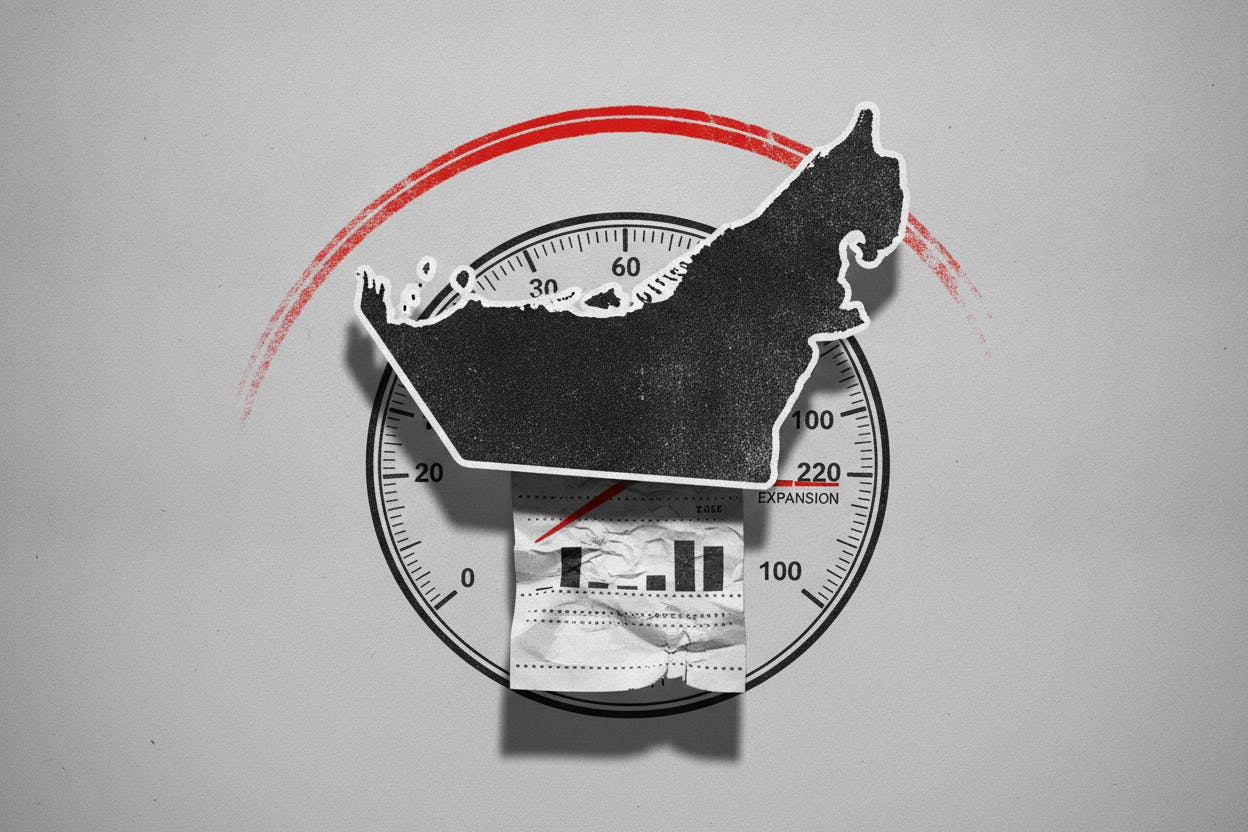
The UAE's non-oil private sector lost significant momentum in June, with a key business survey showing growth nearly grinding to a halt and companies slashing jobs at the fastest pace in nearly four years.
S&P Global's purchasing managers' index (PMI) for the UAE fell to 50.8 in June, down sharply from 52.6 in May. While any reading above 50 signals expansion, the latest figure is only a whisker above that line, indicating that business activity in the country's non-oil economy is barely growing.
What the PMI Numbers Reveal
The PMI is a monthly survey of purchasing managers at private sector companies. It tracks changes in output, new orders, employment, and costs. A reading above 50 means the sector is expanding; below 50 means it is contracting. The June reading of 50.8 is the lowest since late 2022 and marks a clear deceleration from the solid growth seen earlier this year.
According to S&P Global, the slowdown was driven by softer demand, intensifying competition, and higher input costs. Output growth cooled to its weakest pace since June 2021, while export orders fell for the third consecutive month — the longest stretch of declining exports since 2016. That suggests external demand, particularly from key trading partners, is weakening.
Domestic spending and government investment helped cushion the blow, preventing a sharper downturn. But the survey's employment component was particularly worrying: companies cut staff at the fastest rate since August 2020, when the global economy was still reeling from the initial shock of the pandemic. This points to businesses becoming more cautious about their cost bases and future demand.
Broader Context: A Regional and Global Slowdown
The UAE's non-oil sector has been a bright spot in the region's economy, benefiting from tourism, real estate, and financial services growth. However, the June PMI data suggests that the post-pandemic recovery is losing steam. This is not happening in isolation: other economies are also showing signs of cooling. For instance, Chile's economy slipped again as copper output plunged, while Canada posted strong growth but faces tariff risks. The global backdrop of high interest rates and persistent inflation is weighing on demand across many markets.
The UAE's non-oil sector is particularly sensitive to global trade and investment flows. The three-month decline in export orders is a red flag, as it suggests that key export markets — including Asia, Europe, and other Gulf states — are pulling back. This could be linked to slower growth in China, the euro zone's ongoing struggles, and tighter monetary policy worldwide.
What It Means for Investors
For investors with exposure to the UAE, the June PMI data is a warning sign that the non-oil economy is losing momentum. Companies in sectors like retail, hospitality, construction, and logistics may face headwinds as demand softens and competition intensifies. The sharp rise in job cuts also suggests that corporate profitability could come under pressure, as firms try to protect margins by reducing headcount.
However, the UAE's economy remains diversified, and the government's investment spending — particularly in infrastructure and technology — provides a buffer. The country's oil sector, which is not captured in this PMI survey, continues to generate substantial revenue, supporting fiscal spending.
Investors should watch for further PMI readings in the coming months to see if the slowdown deepens or stabilizes. A sustained drop below 50 would signal contraction, which could have broader implications for the UAE's stock market and real estate sector. On the other hand, if domestic demand holds up and global conditions improve, the non-oil sector could rebound.
For now, the data suggests a cautious outlook. The UAE's non-oil economy is not in crisis, but it is clearly losing steam. Companies are tightening their belts, and investors should be prepared for a period of slower growth.