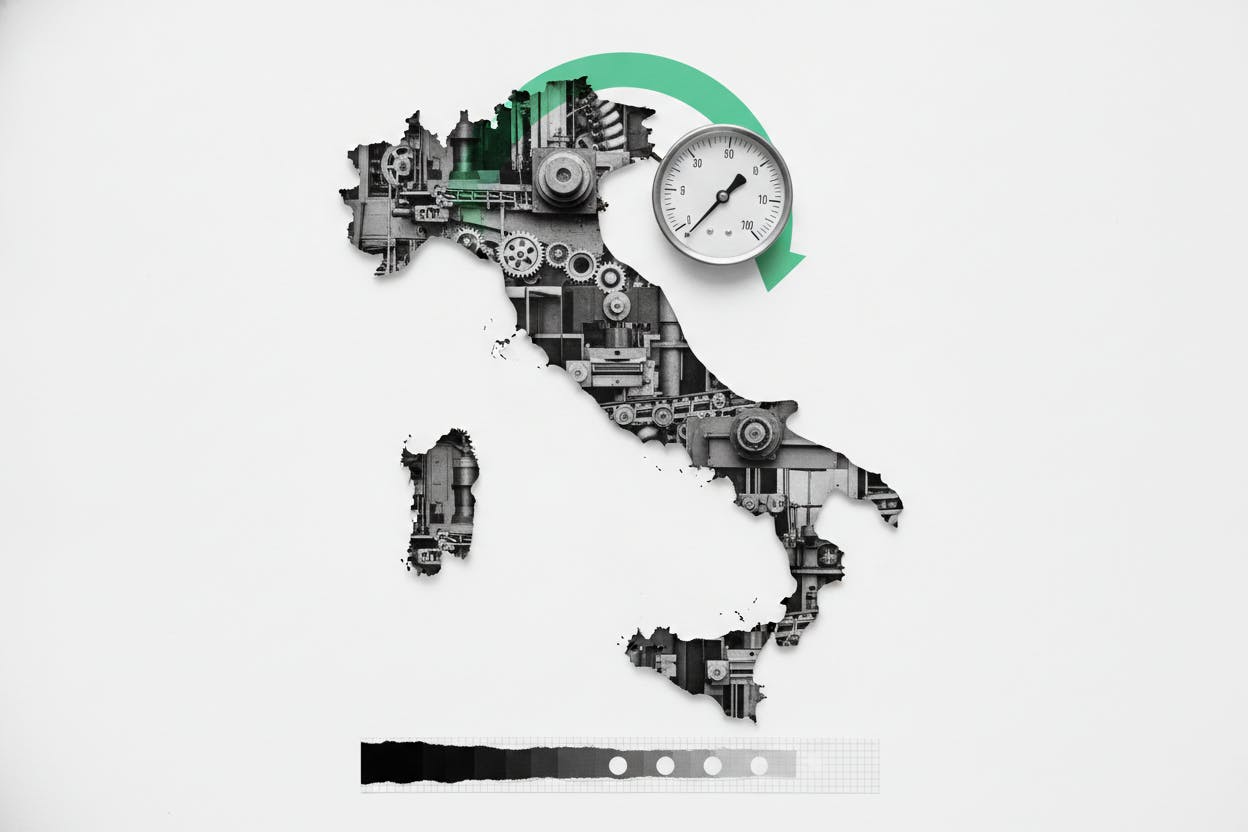
Italian manufacturers got a modest break in June as the latest S&P Global purchasing managers' index (PMI) showed both input costs and selling prices cooling, even though overall factory growth slowed a touch. The data offers a glimmer of hope that the worst of cost-push inflation may be passing for Europe's third-largest economy.
What the PMI Numbers Show
The headline manufacturing PMI for Italy dipped to 52.2 in June from 52.9 in May. For context, any reading above 50 signals expansion, while below 50 indicates contraction. So Italian factories are still growing — just at a slightly slower pace.
The more notable shift was in the price components. The input-cost index fell to 74.3 from 76.5, marking its first decline this year. That means fewer manufacturers reported higher costs for raw materials, energy and other inputs. The output-price gauge — which tracks what factories charge their customers — eased to 60.6 from 62.3, the first drop since December.
These moves suggest that the intense cost pressures that have squeezed Italian industry for months are starting to ease. When input costs rise more slowly, companies have less need to hike their own prices, which can help cool broader inflation.
Why This Matters for Investors
For everyday investors, the PMI is a useful leading indicator of economic health. A reading above 50 means the manufacturing sector — a key driver of Italy's economy — is still expanding. The slight slowdown isn't alarming; it's more of a normalization after a strong run.
The bigger story is the easing of price pressures. If this trend continues, it could mean that the European Central Bank (ECB) faces less pressure to keep raising interest rates. Lower rates tend to support stock valuations and reduce borrowing costs for companies. That's especially relevant for investors holding Italian stocks or European-focused funds.
Italy's factories have been grappling with high energy costs and supply chain disruptions since Russia's invasion of Ukraine. The PMI data suggests those headwinds may be fading, though they haven't disappeared entirely. The input-cost index at 74.3 is still elevated — well above the 50 mark — so costs are still rising, just less rapidly.
Broader Context: Global Manufacturing Trends
Italy's experience mirrors what we're seeing in other major economies. Japan's factories posted their best quarter in over a decade with a PMI of 54.8, while the U.S. and eurozone have seen mixed signals. The common thread is that supply chains are healing and commodity prices are stabilizing, though the pace varies by region.
One factor that could help Italian manufacturers further is the recent dip in commodity prices. Australia's commodity prices dipped in June, driven by weaker base metals, which feeds into lower input costs for industrial users. Similarly, battery metal prices have recovered on supply cuts, but the overall trend is less inflationary than last year.
For Italian companies like tire maker Pirelli, which recently announced a $1.2 billion U.S. expansion, lower input costs could boost margins. That's a positive for investors in Italian industrials and European equities more broadly.
What to Watch Next
Investors should keep an eye on the next few PMI releases to see if the easing trend continues. If input costs keep falling, it could signal that inflation is truly peaking in the eurozone. That would be a tailwind for bonds and growth stocks, which tend to benefit from lower interest rate expectations.
Also watch for the ECB's next policy meeting. If PMI data across the eurozone consistently shows cooling price pressures, the central bank may feel more comfortable pausing its rate hikes. That would be a positive for Italian government bonds, which have been under pressure due to the country's high debt levels.
For now, the June PMI is a modestly encouraging sign. Italian factories are still humming along, and the cost relief they're seeing could help protect corporate profits and keep the economy on a steady footing.