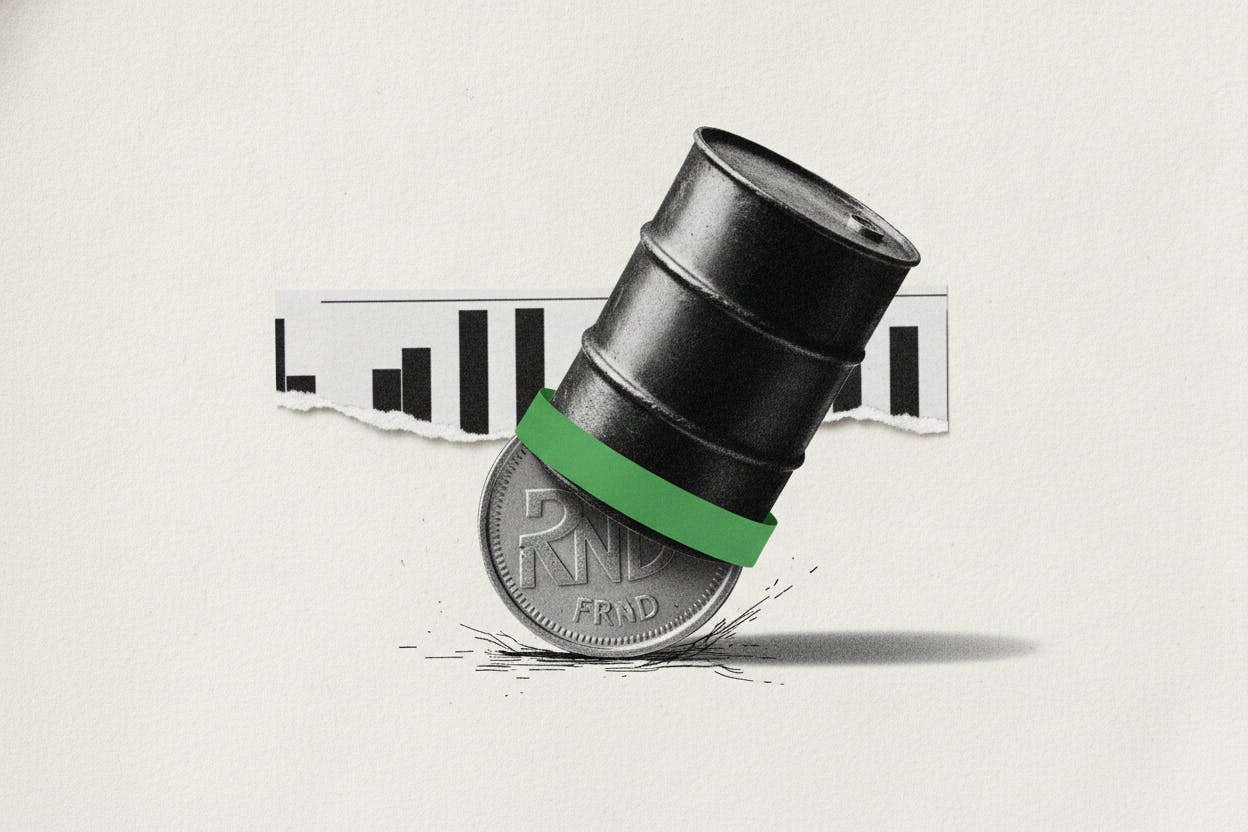
South Africa's rand held its ground on [day] despite news that the economy shrank in the second quarter. The currency's resilience comes as global investors keep their attention fixed on two bigger forces: oil prices hovering near $100 a barrel and the latest US inflation reading due out this week.
Normally, a quarterly economic contraction would put a currency on the back foot. But traders appear to be treating South Africa's dip as old news, focusing instead on the global currents that move money into and out of emerging markets like South Africa.
Why oil matters for the rand
South Africa is a net importer of crude oil, meaning it buys more from abroad than it sells. When Brent crude climbs toward $100 a barrel, the country's fuel import bill swells. That widens the current account deficit—the gap between what the country earns from exports and what it pays out to the rest of the world.
A wider deficit typically puts downward pressure on a currency, because more local currency is being sold to buy foreign oil. Yet the rand has so far shrugged off that pressure, partly because higher oil prices also tend to lift demand for commodities that South Africa exports, such as gold and platinum. That dual effect can leave the currency in a delicate balance.
Oil's rise has been driven by attacks on shipping in the Middle East and ongoing tensions between the US and Iran. Any further escalation could push prices even higher, which would hit South Africa's terms of trade and potentially weaken the rand.
The GDP contraction: a closer look
South Africa's economy contracted by 0.2% in the second quarter, according to official data released earlier this week. That followed a period of sluggish growth, and the contraction was partly blamed on weaker demand linked to the Iran war and global uncertainty.
For everyday South Africans, a shrinking economy often translates into slower job creation and tighter household budgets. But for currency traders, the GDP number was less of a shock than it might have been, because markets had already priced in a weak reading. The rand's stability suggests investors are looking past the immediate data and toward what comes next.
As we noted before the release, the market was bracing for a contraction, so the actual figure didn't trigger a sell-off.
US inflation: the next catalyst
The bigger test for the rand—and for emerging markets broadly—will come with the release of US inflation data later this week. If inflation comes in hotter than expected, it could prompt the Federal Reserve to keep interest rates higher for longer. That tends to strengthen the US dollar and pull capital out of emerging markets, putting pressure on currencies like the rand.
Conversely, a cooler inflation reading could raise hopes of rate cuts, which would be supportive for riskier assets and emerging market currencies. The rand has been sensitive to shifts in US rate expectations, as higher US yields make dollar-denominated assets more attractive relative to South African ones.
Investors are also watching the broader market mood, which has been jittery as oil prices climb and geopolitical risks simmer. Asian stocks have faded on similar concerns, and European markets have been steady but cautious.
What it means for investors
For South African investors, the rand's stability is a double-edged sword. A weaker rand would push up the cost of imported goods, fueling inflation and potentially forcing the central bank to keep interest rates higher. That would squeeze borrowers and could weigh on local stocks. A firmer rand, on the other hand, helps keep inflation in check and gives the Reserve Bank more room to ease policy if needed.
For global investors with exposure to South African assets, the key takeaway is that the currency is being driven more by external factors than by domestic fundamentals right now. Oil prices and US monetary policy are likely to remain the dominant forces in the near term.
As always, it's important to remember that currency movements are notoriously hard to predict. Rather than trying to time the rand, most financial advisers recommend focusing on a diversified portfolio that can weather swings in any single currency or market.
The coming days will show whether the rand can maintain its composure. If US inflation surprises to the upside, or if Middle East tensions escalate further, the currency could come under renewed pressure. But for now, it's holding steady—and that's a small relief for investors who had braced for worse.