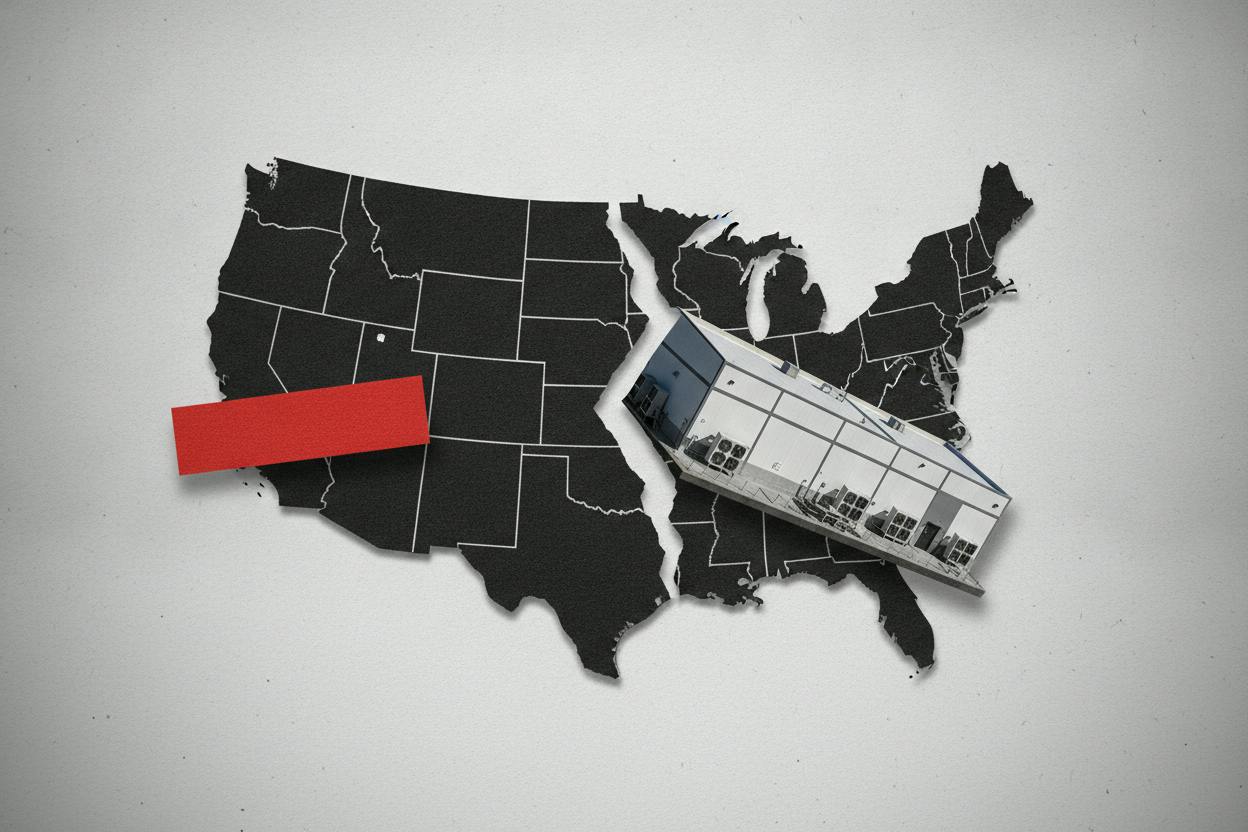
Morgan Stanley, one of Wall Street's biggest investment banks, has warned that a wave of new state-level rules could slow the construction of artificial intelligence data centers in parts of the US. The cautionary note landed on a day when the market's tech sector showed a clear split: broad technology stocks held steady, but the chipmakers that power AI took a hit.
On Wednesday, the Technology Select Sector SPDR Fund, a popular exchange-traded fund that tracks large tech companies, rose 0.3%. But the SPDR S&P Semiconductor ETF fell 3.2%, and the Philadelphia Semiconductor Index, a benchmark for chip stocks, slid 3.6%. That divergence is exactly what Morgan Stanley's analysts are pointing to: the AI boom is no longer lifting all tech boats equally.
Why state rules matter for AI
Data centers are the physical backbone of AI. They house the powerful servers and cooling systems needed to train and run large language models and other AI applications. For years, these facilities have been springing up rapidly, especially in states with cheap power and business-friendly policies. But as their energy and water demands grow, local governments are starting to push back.
Morgan Stanley's warning is that tighter permitting, zoning restrictions, and other limits at the state level could create a patchwork of “allowed” and “restricted” zones across the country. In some regions, new data centers will be welcomed with open arms; in others, they could face long delays or outright bans. That uneven landscape makes it harder for companies to plan large-scale AI infrastructure, and it could slow the pace of the entire AI buildout.
This isn't just a hypothetical concern. Several states have already debated or enacted measures to curb data center growth, citing strain on local power grids and water supplies. The trend is still young, but Morgan Stanley sees it as a growing risk for the companies that depend on a steady flow of new data centers.
What it means for tech stocks
For investors, the key takeaway is that the AI trade is becoming more nuanced. Semiconductor companies—like the ones in the Philadelphia Semiconductor Index—are the most direct beneficiaries of data center construction. If that construction slows, their revenue growth could cool. That's why chip stocks fell so sharply on the news.
Broader tech companies, such as software and cloud providers, may be less immediately affected. They can often shift workloads to existing data centers or use cloud services that spread demand across multiple regions. That helps explain why the Technology Select Sector SPDR Fund held up even as chip stocks tumbled.
But the split also reflects a deeper reality: the AI boom is entering a new phase. Early on, almost any company with an AI story saw its stock rise. Now, investors are starting to differentiate between companies that can navigate the logistical and regulatory hurdles of AI infrastructure and those that can't.
What investors should watch
For everyday investors, the message is not to panic but to pay attention. The AI story is still intact, but it's no longer a one-way bet. Watch for signs of how state governments are treating data center proposals, and keep an eye on how chipmakers and cloud providers talk about their expansion plans in earnings calls.
Also note that this kind of regulatory risk is not unique to AI. Big US stocks have already lost some of their bullish edge as options demand shifts, and political shifts can lift some sectors while hurting others. The data center issue is another reminder that policy decisions at any level—state, federal, or local—can ripple through markets.
Morgan Stanley's warning is a useful reminder that the AI buildout is not just a technology story; it's also a real estate, energy, and regulatory story. For investors, that means the winners and losers in AI could become more geographically and politically defined in the months ahead.
As always, diversification remains a sensible strategy. If you're heavily exposed to chip stocks, you might feel the sting of a slowdown in data center construction. But if your portfolio includes a mix of tech, energy, and utilities, you're better positioned to weather the uneven terrain.