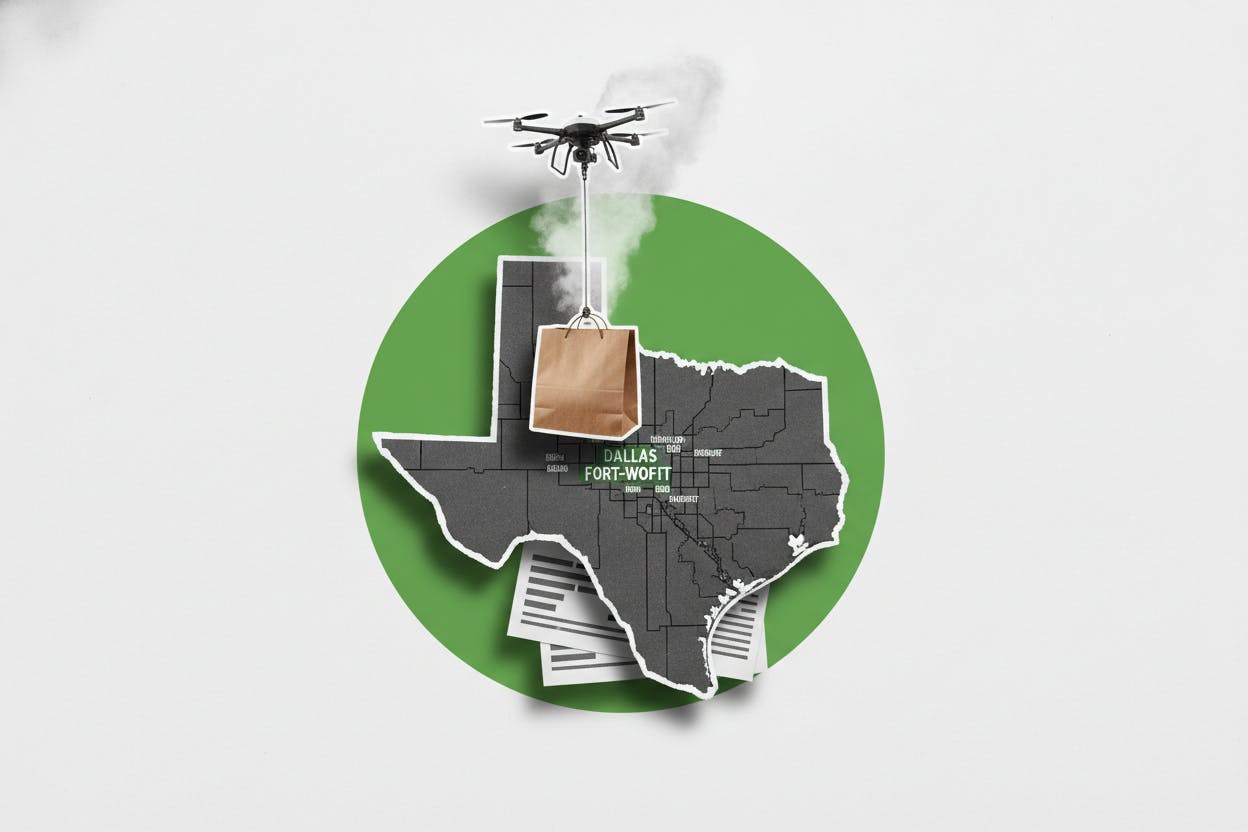
Wonder, the company that owns food-delivery app Grubhub, announced it will start delivering meals by drone in Dallas in January, with plans to expand across other Texas cities through 2027. The service will use drones from Zipline, a San Francisco-based company that already delivers healthcare supplies, retail goods, and food for other partners.
Wonder operates about 130 "foodhalls" — a hybrid model that combines ghost-kitchen cooking with dine-in, takeout, and delivery. The company prepares dishes from multiple restaurant brands under one roof, aiming to offer variety without the overhead of individual restaurants. Now it's betting that drone delivery can give it a competitive edge in speed and consistency.
How Drone Delivery Works
Zipline's drones fly autonomously along pre-approved routes, dropping packages by parachute at designated landing zones. For Wonder, that means meals can go from kitchen to customer in minutes, bypassing traffic and reducing reliance on human couriers. The company has already tested the service in the US Northeast, so Texas is its next big proof point.
The initial Dallas rollout will involve at most a handful of locations, with more drone-enabled sites coming online as the year progresses. Wonder hasn't disclosed exactly how many Dallas foodhalls will participate in January, but the strategy is to start small and scale based on results.
Why Texas Matters for Wonder's IPO Plans
Wonder has been building an integrated food ecosystem through acquisitions. It bought Grubhub for $650 million in 2024 and meal-kit company Blue Apron for $103 million in 2023. The company is now preparing for an initial public offering as soon as 2027, and the drone delivery push is part of the story it will tell investors.
For markets: Wonder's January Dallas rollout puts its delivery margins in the spotlight ahead of a possible 2027 IPO. Drone delivery only changes the math if it replaces a meaningful number of human courier trips. In theory, that shifts last-mile delivery from a labor-heavy, per-order cost to a model with more fixed costs — aircraft, launch sites, and flight operations — that can get cheaper per order as volume rises. That's why Wonder's strategy of clustering demand around its own foodhalls matters: if orders are dense enough, those fixed costs get spread across lots of deliveries, and the profit per order can improve. So starting with just a handful of Dallas locations is less about scale and more about evidence. If Texas shows repeatable improvements in contribution margin per order as Wonder adds drone-enabled sites, it strengthens the core story it'll need for public-market investors if it pursues an IPO in 2027.
Competition Heats Up in Last-Mile Delivery
Wonder isn't alone in chasing drone delivery. DoorDash and Uber Eats are also exploring drones and delivery robots, which raises the bar for what "fast delivery" means. The race is part of a broader push across logistics and transportation to automate the final leg of delivery — the most expensive and time-sensitive part of the journey.
Other companies are also betting on autonomous flight. Toyota recently took a majority stake in Joby Aviation, an air taxi developer, to mass-produce its S4 aircraft. And cargo drone startup Elroy Air announced plans to go public via a SPAC merger valued at $1 billion. These developments show that investors are watching the drone space closely, even as regulatory hurdles and public acceptance remain challenges.
What It Means for Everyday Investors
For ordinary investors, Wonder's drone delivery test is a window into how the company might improve its margins — and whether its IPO story holds water. If drone delivery can reduce per-order costs, it could make Wonder's foodhall model more profitable than traditional restaurant delivery. But the technology is still unproven at scale, and the initial Dallas rollout is tiny.
Investors should watch for updates on delivery times, customer satisfaction, and cost per order as Wonder expands. The company will need to show that drone delivery isn't just a gimmick but a real efficiency gain. If it can, that could make Wonder a more attractive bet when it eventually goes public. If not, the IPO may face tougher questions about its path to profitability.