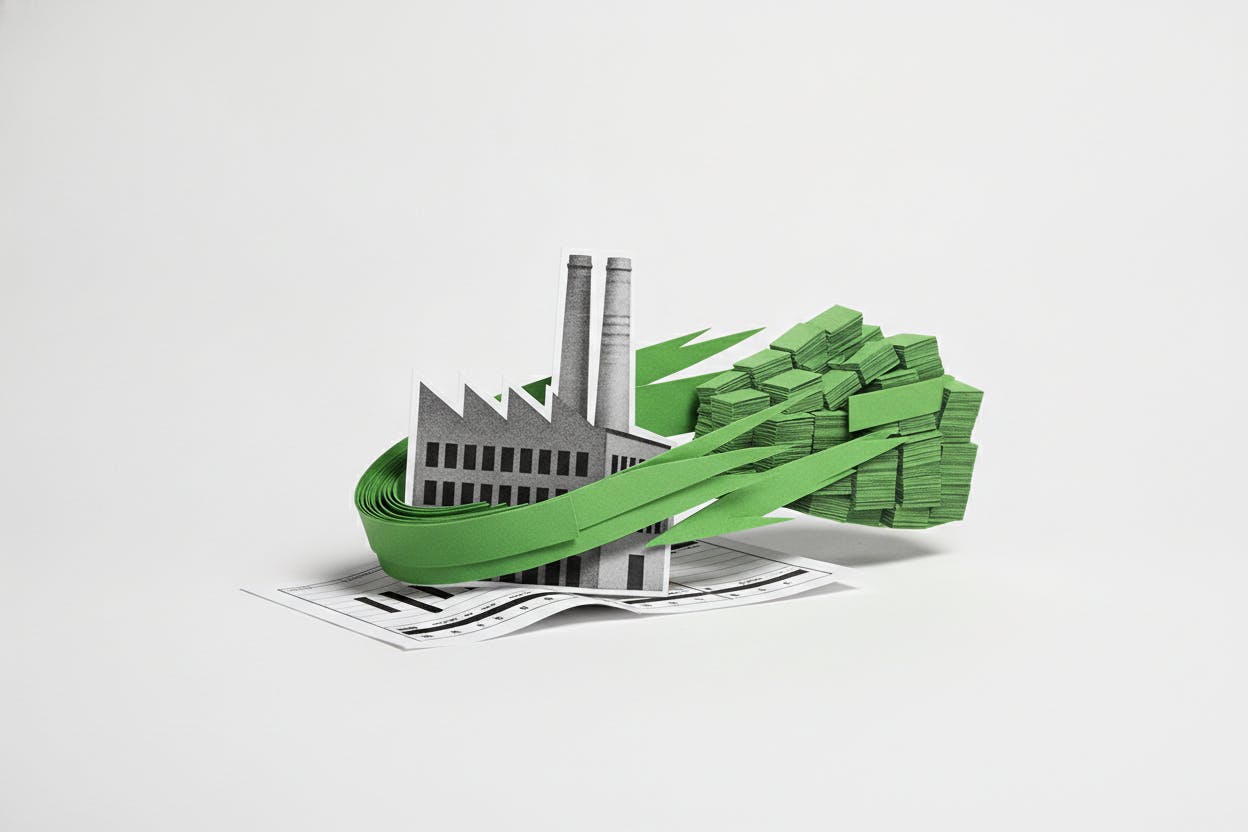
Germany's manufacturing sector picked up speed in August, with a key survey showing the strongest production growth since January 2022. The S&P Global Germany Manufacturing Purchasing Managers' Index (PMI) rose to 54.3, up from 52.2 in July, according to a Reuters-cited survey. A reading above 50 signals expansion, so the increase points to a sector that is not only growing but doing so at a faster clip than a month earlier.
The improvement was powered by a steady flow of new orders, which rose for a third consecutive month. Companies surveyed attributed the demand to several factors, including increased defense spending, the build-out of data centers, and a wave of restocking by businesses. The strength was most evident in intermediate goods—products used to make other goods—suggesting that the recovery is feeding through the supply chain.
What's driving the rebound?
The August data marks a notable turnaround for Europe's largest economy, which has struggled with high energy costs, weak global demand, and a manufacturing slowdown over the past couple of years. The latest PMI reading suggests that some of those headwinds are easing, at least for now.
Defense spending has become a growing driver of industrial demand across Europe, as governments ramp up military budgets in response to geopolitical tensions. Data-center construction is another bright spot, fueled by the boom in artificial intelligence and cloud computing, which requires vast amounts of computing infrastructure. Restocking—where businesses rebuild inventories that were drawn down during earlier slowdowns—also tends to provide a short-term boost to factory orders.
Economists at S&P Global Market Intelligence, including Phil Smith, noted that the production growth was broad-based, though the intermediate goods sector stood out. This suggests that manufacturers are seeing demand not just from end consumers but also from other businesses, which can be a sign of a more durable recovery.
What it means for investors
For everyday investors, the German manufacturing PMI is more than just a number—it's a gauge of health for the eurozone's largest economy and a bellwether for global trade. Germany is heavily export-oriented, so its factories often feel the effects of global demand shifts before other countries do.
The stronger data could be a positive signal for European stocks, particularly those in the industrial and materials sectors. Companies that supply machinery, chemicals, and auto parts may benefit from increased orders. However, investors should be cautious about reading too much into a single month's survey. PMI data can be volatile, and the August reading reflects a period when many businesses are still recovering from summer slowdowns.
It's also worth noting that Germany's inflation rate came in at 2.9% in August, missing forecasts, as recent reports have highlighted. That could influence the European Central Bank's next moves on interest rates, which in turn affect borrowing costs for companies and consumers. If inflation continues to cool, the ECB might feel more comfortable cutting rates, which could further support economic activity.
Broader European context
Germany's factory revival stands in contrast to some of its neighbors. For instance, Poland's factory slump deepened in August, with its PMI falling to 48.3, indicating contraction. Meanwhile, Ireland's factory growth hit a near four-year high, showing that the picture across Europe is mixed.
Outside Europe, China's factory activity picked up in August as export orders surged, and South Korea saw export orders surge even as overall growth cooled. These trends suggest that global manufacturing may be stabilizing, which could be a tailwind for trade-dependent economies like Germany.
Looking ahead
Investors will be watching to see whether the German manufacturing rebound has staying power. Key indicators to monitor include future PMI readings, industrial production data, and export figures. The strength in new orders is encouraging, but it remains to be seen whether it translates into sustained output growth.
For now, the August PMI offers a reason for cautious optimism. It suggests that Germany's factories have found a second wind, and that the broader European economy may be turning a corner. But as always, the data is just one piece of the puzzle, and investors should keep an eye on the bigger picture.